Saturday, April 21, 2012

No. 124: Residential use fuel cell is advancing and growing (April 21, 2012)

Business trend of the smart house market (5/8)
Residential use fuel cell
The residential use fuel cell sales were about 16 billion yen in 2010, and they will grow about 85 times to 1,400 billion yen in 2025 in 11 major markets in Asia including Japan, Europe, and North America. The three countries that actively promote residential use fuel cell are Japan, Korea, and Germany, and Japan outpaces other two. It may be hard to establish substantial business in North America because energy cost is not high there. As the special measures to stimulate the spread of renewable energy, the central government allow electricity generated by renewable energy to be sold beginning in July in Japan. Currently, three companies of JX Oil and Energy, Tokyo Gas, and Osaka Gas are very active in the market, but other companies are going to participate in this market.

The large-scale generation inevitably wastes heat energy in time of generation even though generation efficiency is high. If a household is equipped with a residential use fuel cell, it can generate electricity for such applications as lights, hot water supply, and heating without waste. Depending on the materials to be used, the residential use fuel cell can roughly be divided into (1) Solid oxygen fuel cell (SOFC) and (2) Polymer electrolyte fuel cell (PEFC). The residential use fuel cell is still expensive, and most consumers need to rely on the subsidy for introduction. It is urgent task for the industry to reduce production cost, establish a mass production system, and increase generation efficiency. 

Ene-Farm (residential use fuel cell) from JX Oil and Energy 


Thursday, April 19, 2012

No. 123: Toyota builds a plant factory to grow paprika using waste heat coming from the adjacent car manufacturing plant (April 19, 2012)

Technology
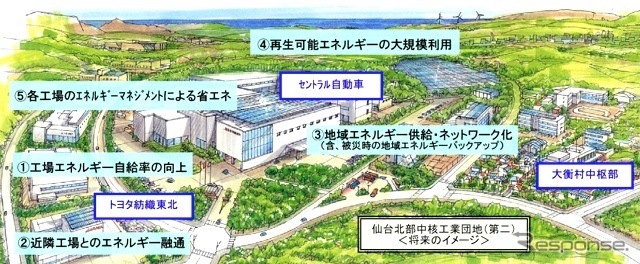
Toyota and Toyota Tsusho jointly announced that they would build a plant factory to grow paprika in the land adjacent to a plant of Central Motor that is one of Toyota’s subsidiaries. The plant factory will utilize waste heat coming from the in-house power generation of CentralMotor and reduce the cost to heat the greenhouses by 25%. Vegi Dream, a Toyota Tsusho’s subsidiary, will borrow a 3 ha site and build a large-scale steel house with a growing area of 1.8 ha. The factory plant will be ready for production in January 2013, and will grow 315 tons of paprika per year.

Heat generated by the cogeneration equipment introduced by Central Motor boils water that is used for heating the greenhouse during nighttime. This project is part of Toyota’s “F-Grid Concept” designed for effective usage of energy inside an industrial complex. Vegi Dream already built three paprika farms with a total area of 5 ha. The new plant factory is the third one of this company.   

 Toyota's F-Grid Concept

Sunday, April 15, 2012

No. 122: Solar heat application (4/8) (April 15, 2012)

Business trend of the smart house market (4/8)
Solar water heater
Solar heat application is divided into two methods: using calorie of solar heat, such as solar system and solar water heater, and using energy of solar heat by converting it as electricity energy, such as photovoltaic generation and solar battery. The solar water heater is divided into the natural circulation type and the controlled circulation type solar system, and the applications have expanded from hot-water supply to heating and cooling. In particular, the solar collector called solar wall was highly praised by the United State Department of Energy.

Devices using solar heat have a high degree of energy conversion efficiency, and the installation cost is relatively low. In addition, they maintain high cost efficiency. Japanese solar heat application devices enjoy a high popularity in the world thanks to their high in performance and durability. Generally, a household creates hot water using a solar water heater and applies the water to heating, bath, and kitchen work. Because one third of household’s carbon dioxide emission is from water heating, solar water heater is an excellent idea. 

Popular solar heat application: 
Water in the container is heated by sunlight, and hot water is used for heating, bath, and kitchen work. 
Water heating system using sunlight

Players in solar heat application

Sunday, April 1, 2012

No. 121: The smart house market grows responding to ever increasing demand for energy-saving houses (3/8) (April 1, 2012)

Business trend of the smart house market (3/8)
LED and organic LED
LED plays a very important role in the smart house business, and LED producers are busily expanding production capacity. Mitsubishi Chemical is building a plan to produce gallium nitride substrates. LED illuminations currently on the market are based on sapphire substrate, but gallium nitride substrate consumes 50-70% less power and is more resistant to high power than sapphire substrate. The new plant will start producing gallium nitride substrates for 100,000 LED bulbs per month starting in coming October. The company plans to increase LED-related sales including sales of gallium nitride substrates from 21 billion yen in 2011 to 100 billion yen in 2015. The company president said, “Organic solar battery, lithium-ion battery materials, and gallium nitride substrate will become the three sacred treasures for the growth of his company.”

Sumitomo Chemical focuses on organic electroluminescence. It has a high degree of energy efficiency because it emits light by itself. In addition, as the lighting fixture can be as thin as several centimeters thick, it is possible to create a ceiling that emits light. The company plans to increase the brightness and decrease the price comparable to a fluorescent lamp toward 2015. According to a research company, the domestic LED market is estimated at 140 billion yen, of which 93 billion yen was sales of LED lamps, in 2011.  

A railway station in Tokyo illuminated by organic electroluminescence lighting


Monday, March 26, 2012

No. 120: The smart house market grows responding to ever increasing demand for energy-saving houses (2/8) (March 27, 2012)

Business trend of the smart house market (2/8)
Storage battery
With the development of the smart house concept, it will become possible to realize self-support of required electricity, sell surplus electricity, share electricity between house and car, and make life in house more convenient. Accordingly, a device to store electricity will grow indispensable to our daily life.

A research firm conducted interviews with major players of the storage battery market and found that the market would increase 40 times over the level in 2011 to 935 million WH. The market was about 23,000 WH in volume and 15,600,000 yen in value in 2011. Of the total shipments, lithium-ion battery accounted for 75%, lead 24%, and NA 1%. Lead battery accounted for 55% of storage batteries for new residential houses. Portable storage battery accounted for 55.8%, followed by stationary battery with 30.4%. A total of 21 types of stationary battery were shipped in 2011, of which five used lead battery and 16 employed lithium-ion battery. The average cost of WH was 427,000 yen for lead battery and 512,000 yen for lithium-ion battery.

Housing companies are introducing houses equipped with storage battery one after another, it is well expected that the market will grow substantially beginning this year. 
 NEC's storage battery system for smart house

Saturday, March 24, 2012

No. 119: The smart house market grows responding to ever increasing demand for energy-saving houses (1/8) (March 25, 2012)

Business trend of the smart house market (1/8)
Photovoltaic generation
Facing power shortage due to the March 11 disaster in the Tohoku district, Japan is required to work out measures for an even more energy-saving society. Supported by IT technology, the smart house market is growing rapidly and expected to reach 12 trillion yen worldwide in 2020. It covers a wide variety of industries including generation, energy-saving equipment, sensors, and management systems. This article is the first of the eight articles on various industrial fields involved in the smart house market. It focuses on the photovoltaic generation business and the relations of companies involved in the business.

According to a research firm, the smart house business excluding housing structure was 2,708 billion yen in 2011 and it will grow to about 12,000 billion yen in 2020 worldwide. Japan is the largest market, accounting for 30% of the world market. The business model of smart house has not been established, but it will ultimately be a smart community that can supply energy for itself even in a time of disaster through the collaboration of such distributed power sources as photovoltaic generation, wind generation, and generation using waste heat and waste materials. In a sense, efforts for faster recovery of the areas devastated by the March 11 disaster facilitate the growth of the smart house business in Japan. 

Sunday, March 18, 2012

No. 118: Using food residues and sludges for power generation (March 18, 2012)

Business trend
The idea of utilizing biomass resources like food residues is supported by the Ministry of the Environment thought its policy to stimulate the introduction of nonprocess waste energy. Environment renaissance, an environment business company in Tokyo, will start a project that combines agriculture and methane gas generation using wastes from food plants. The project tries to integrate methane gas generation, apiculture, and feed production through algae culture. It plans to build methane fermenters and algae culture tanks in a 10,000-square-meter area. Food residues and sludges from food plants will be fermented to collect methane gas that will be used for power generation.

In the case that food residues and sludges received are 9,000 tons a year, the projected plant will be able to supply electricity to 200 households, and collect 1,935 tons of composts and 7,222 tons of liquid fertilizers from the fermenters. In addition, the project will address apiculture and culture algae. The project plant is scheduled to start running in 2013. The company is receiving inquiries from other local governments inside Japan and abroad, and planning to expand business in Vietnam and Indonesia in the future.